
Implant rehabilitation that brings your smile back
If you've lost several teeth, or you're tired of dentures that don't fit the way they should, implant rehabilitation can give you a fixed, stable smile that looks and feels like your own. We'll plan it together at My E20 Dentist.
- Free consultation with Dr Maria Mitran (worth £100)
- Surgery led by oral surgeon Dr Ionel Nistor
- 0% APR finance on treatments over £1,000

A whole new chapter for your smile
Living with multiple missing teeth or unstable dentures wears people down. It changes how you eat, how you speak, even the photos you say yes to. Implant rehabilitation is the modern fix.
Rather than replacing teeth one by one, implant rehabilitation uses a small number of carefully placed implants to support a full set of fixed teeth. The result is a smile that stays put when you talk, when you laugh, when you eat what you actually want to eat.
We see patients from across Stratford, East Village, Forest Gate, Hackney, Leyton, Wanstead, East Ham, Plaistow and Canary Wharf for this work, often after years of struggling with traditional dentures.

What is implant rehabilitation?
Implant rehabilitation is the term for using dental implants to replace several missing teeth at once, rather than just one. A dental implant is a small titanium post that takes the place of a missing tooth root. Once it's healed into your jaw, we attach a new tooth (or several teeth) to it.
Depending on what you need, your treatment might involve a fixed full set of teeth supported by four implants (often called All-on-4), a denture that clips onto a few implants for stability, or a fixed bridge of teeth supported by a few implants in a row. We'll recommend the right option for you at your consultation.

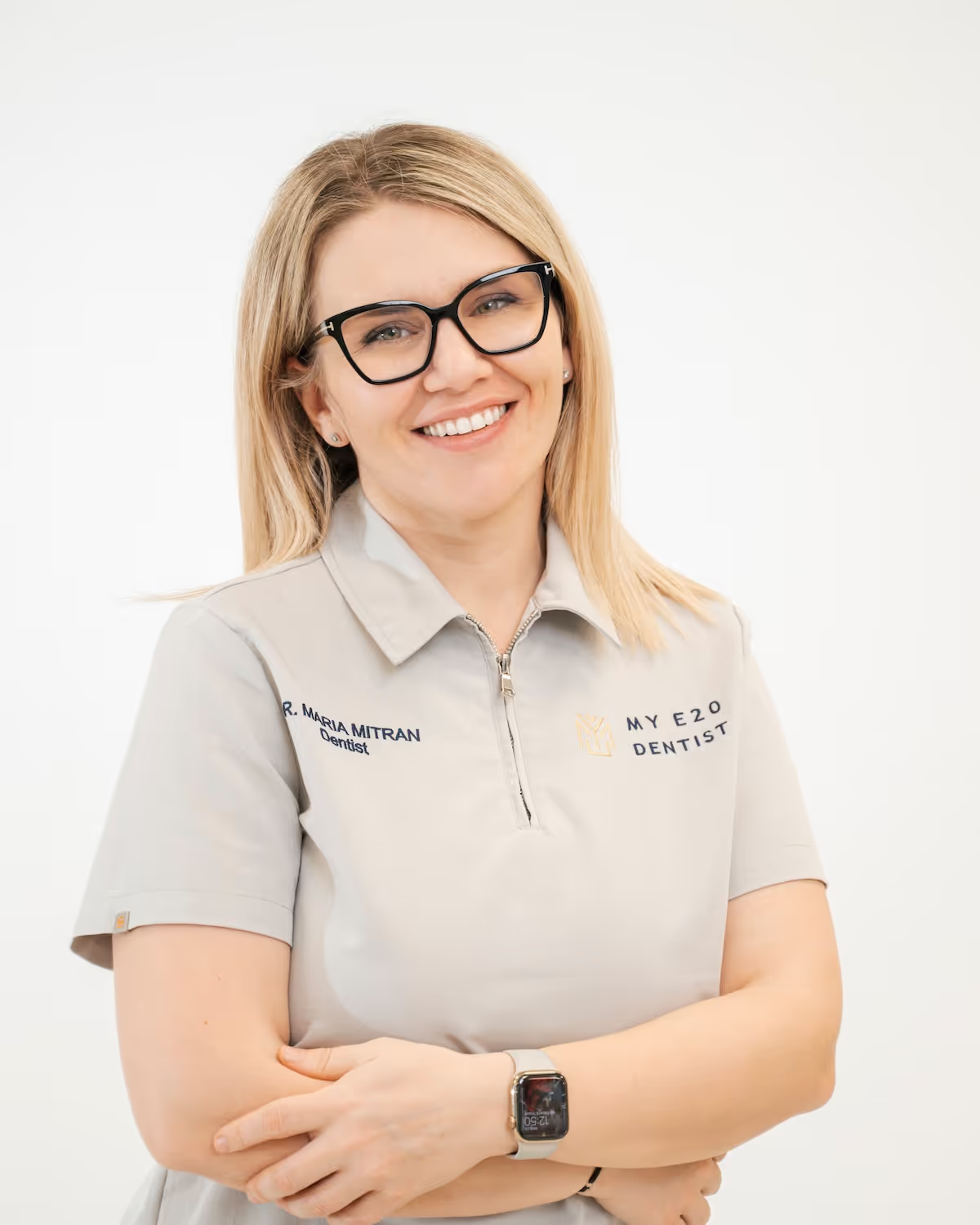
Dr Maria Mitran
Dr Maria is our restorative dentist and the lead clinician for implant rehabilitation cases at My E20 Dentist. She handles the consultation, planning and final restoration of every implant case.
Her background spans full mouth rehabilitation, restorative work and complex cosmetic cases. She works closely with our oral surgeon Dr Ionel Nistor so the surgical and restorative sides of your treatment are joined up from day one.
Dr Ionel Nistor
Dr Ionel is our visiting oral surgeon. He qualified in Romania in 2011, completed a Master's in Clinical Dentistry in Oral Surgery in London (2020) and a postgraduate certificate in Implantology in London (2019), and has trained with leading academies in Switzerland and the UK.
Dr Nistor handles complex implant surgery, including cases where extra bone is needed to support the implants. He's known for thorough planning, honest recommendations and the kind of careful work that makes the rest of the treatment go smoothly.

Surgery and restoration, under one roof
Implant rehabilitation at My E20 Dentist is delivered as a partnership. Dr Maria Mitran plans the case and creates your final teeth. Dr Ionel Nistor performs the surgery.
That joined-up approach matters. It means the implants are placed exactly where they need to be for the final restoration to look and function its best. It also means there's one team responsible for your whole treatment, start to finish.

Your implant rehabilitation journey
Every case is different, but the journey usually follows these five stages. We'll talk you through every one of them at your free consultation.

Your free consultation
You'll meet Dr Mitran, talk through what's been bothering you and have a proper examination. We'll discuss what's possible and what we'd recommend, with no obligation to go ahead.

3D scan and planning
If implants look like the right option, we'll take a 3D scan of your jaw (£200) so we can see exactly where to place them. This is what allows the surgery to be accurate and safe.

Implant surgery
Dr Nistor places the implants under local anaesthesia. Most patients are surprised at how comfortable it is. In some cases we'll fit a temporary set of teeth on the same day so you leave with a smile.

Healing and bonding
Over the next three to six months, the implants bond securely with your jawbone. You'll come back for a few short check-up appointments during this time.

Your permanent teeth
Once healing is complete, Dr Mitran fits your final teeth. Custom-made to suit your face, your bite and your preferences. The finished result is yours to enjoy.

What's included in your implant rehabilitation
Every case is planned individually, but treatments commonly involved include:
You'll receive a fully costed plan after your consultation.

Premium implant systems
We use top-tier implant systems from Sweden and Martina, Bredent and Megagen. These are some of the most respected names in implantology globally, chosen for their long-term track record and the quality of the final result. It matters to us, and it should matter to you.

Nervous about implant surgery?
Implant surgery sounds intimidating until you've actually been through it. The reality is calmer than most people expect. The procedure is performed under local anaesthesia, you'll feel pressure rather than pain, and most patients tell us afterwards that it was easier than a tooth extraction.
We take the time to explain every stage in plain language. You'll know exactly what's happening and why. If anxiety is a particular concern, please mention it at your consultation so we can plan accordingly.


Spreading the cost
Implant rehabilitation is a significant investment, and we make it manageable. We offer 0% APR finance on treatments over £1,000, with payments spread over up to 12 months and a £500 deposit.
Full pricing is available on our fees page, and you'll receive a detailed treatment plan and cost breakdown after your free consultation.


Frequently asked questions
Most cases take between three and nine months from initial surgery to final teeth, depending on healing time and whether extra bone support is needed. With the All-on-4 method, you'll often leave with a temporary set of teeth on the day of surgery, so you're never without a smile during treatment.
Often yes. We routinely treat patients who've been told elsewhere they aren't suitable. Modern grafting techniques and the All-on-4 approach mean very few people are genuinely ineligible. Your free consultation and 3D scan will give you a definitive answer.
That's the entire point. Dr Mitran designs the final teeth to suit your face, your features and your bite. We're not trying to give you generic teeth, we're trying to give you teeth that look like they belong to you.
With proper care, implants can last a lifetime. The teeth attached to them may need refurbishing over the years, but the implants themselves are designed as a permanent solution. Good oral hygiene, regular check-ups and avoiding smoking all help to maximise their lifespan.
You'll meet Dr Mitran, talk through your concerns and goals, and have an examination. If a 3D scan is needed for accurate planning, that's an additional £200. You'll leave with a clear picture of your options and a no-obligation treatment plan.
The implant surgery itself is performed under local anaesthetic, so the area is completely numb throughout. Dr Nistor makes a small opening in the gum, places the titanium implants into pre-planned positions in your jawbone, and closes everything up. For All-on-4 cases, a temporary set of teeth is often fitted on the same day, so you walk out with a smile already in place. Most patients are surprised at how comfortable and straightforward the actual surgery feels.
Most patients are back to normal activities within 2 to 3 days. Some swelling, bruising and mild discomfort are normal for the first week, all of which respond well to over-the-counter pain relief. You'll be on a soft food diet for a couple of weeks to protect the area, and Dr Nistor will see you for short follow-up appointments to check on healing. Avoiding smoking is particularly important during this stage.
No. For most All-on-4 cases, a temporary set of fixed teeth is fitted on the same day as the implant surgery, so you're never without a smile. For other cases, a temporary denture can be used during the healing period. Dr Mitran will plan this out with you at your consultation so you know exactly what to expect.
Implant rehabilitation has a very high success rate, but as with any surgery there are risks to be aware of. Possible complications include infection at the surgical site, implant rejection (rare), nerve sensitivity (rare), or in the upper jaw, sinus issues if a sinus lift is involved. Smoking, uncontrolled diabetes and poor oral hygiene can all affect healing. Dr Nistor will go through every risk in detail at your consultation and use 3D imaging to plan the surgery as precisely as possible to minimise them.
Very close, yes. Implants are fixed firmly into your jawbone, so they don't move, slip or come out the way dentures do. Most patients say their implant teeth feel completely natural within a few weeks, and they're able to eat, speak and smile without thinking about them. The bite force is significantly stronger than dentures, which is one of the biggest changes patients comment on.
Yes, once fully healed. Unlike traditional dentures, implant-supported teeth let you eat almost anything you want, including steak, apples, crusty bread and the foods many denture wearers have to avoid. We do recommend being cautious with very hard foods (ice, hard sweets) the way you would with natural teeth.
For most patients, speech improves with implant-supported teeth, particularly if you've struggled with loose dentures. There may be a short adjustment period of a few days to a few weeks as your tongue gets used to the new shape of your teeth, but most patients settle into it quickly.
It's a substantial step up. Traditional dentures rest on the gums and can slip, click, or feel uncomfortable. They also don't stop the jawbone from shrinking over time, which is why dentures often need refitting every few years. Implant rehabilitation gives you a fixed, stable smile, preserves the jawbone underneath, and feels much more like your own teeth. The trade-off is the upfront cost and the time involved, but most patients find it transformative.
The All-on-4 method uses just four strategically placed implants to support a full set of fixed teeth, rather than one implant per tooth. It's particularly clever because the implants are angled to take advantage of the strongest parts of your jawbone, often avoiding the need for bone grafting even when bone has been lost. For many patients, it means a quicker treatment with less surgery and the same long-term results.
Day to day, brush twice a day and use special brushes or floss designed for implants to clean underneath and around the bridge. Regular check-ups and hygiene appointments are essential to spot any early signs of issues. Avoiding smoking is particularly important, as it significantly affects long-term implant health. With good care, your implants can last for decades.
If anything feels different (looseness, soreness, gum changes), get in touch straight away. Most issues are minor and easily resolved if caught early. In the rare case that an implant fails, it can usually be removed and the area allowed to heal before a new implant is placed. Regular check-ups make spotting any small issues early much more likely.
Book your free implant rehabilitation consultation in London's E20
Spend an hour with Dr Mitran, get honest answers, and find out what's possible for your smile. The consultation is free, and there's no pressure to commit.


